How Many Weeks in a Year? A Simple Guide to the Calendar

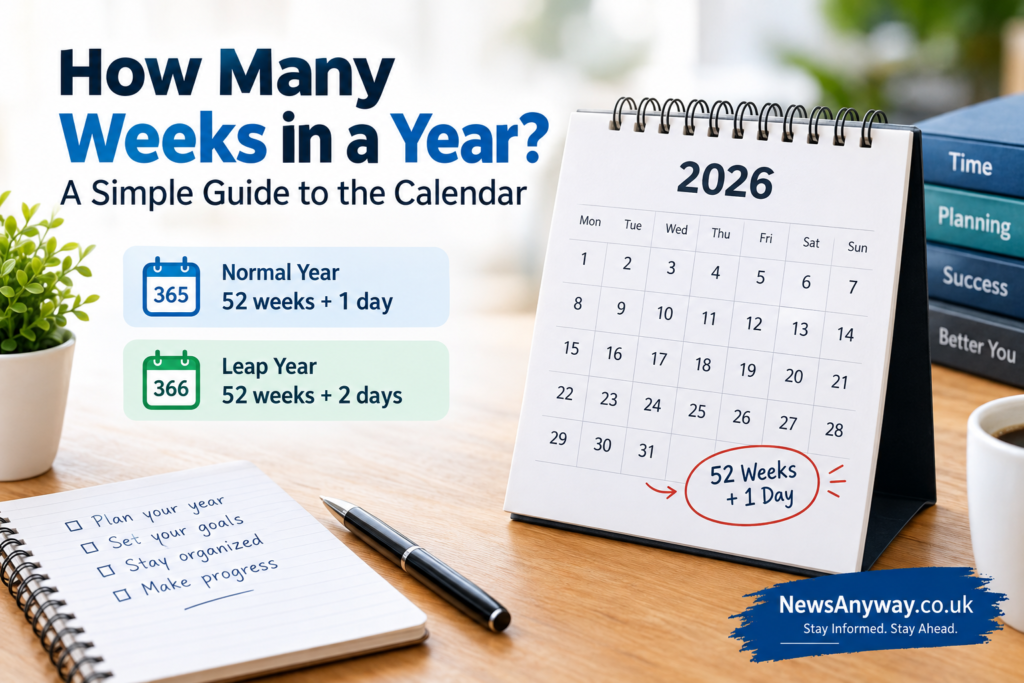
If you have ever planned a yearly schedule, created a savings challenge, organized a work project, or simply wondered how time is divided, you may have asked: how many weeks in a year? The simple answer is 52 weeks, but there is a little more to the calculation than that.
A standard calendar year contains 365 days. Since one week has seven days, dividing 365 by seven gives approximately 52.14 weeks. In practical terms, that means a normal year contains 52 complete weeks and one extra day. A leap year contains 366 days, which equals 52 complete weeks and two extra days.
Understanding this small difference can be useful when planning calendars, work schedules, budgets, fitness programs, school terms, or long-term personal goals.
How Many Weeks Are in a Normal Year?
A normal or common year has 365 days. To calculate the number of weeks, divide the total number of days by seven:
365 ÷ 7 = 52.142857
This means there are 52 full seven-day weeks, with one day remaining.
Another way to see it is:
52 × 7 = 364 days
Because a normal year has 365 days, there is one day left after 52 complete weeks.
For everyday purposes, people generally say that a year has 52 weeks. This is the most useful answer when discussing annual plans, schedules, or general time periods.
How Many Weeks Are in a Leap Year?
A leap year has 366 days instead of 365. The extra day is added to February, making it 29 days long.
The calculation is:
366 ÷ 7 = 52.285714
Therefore, a leap year contains 52 complete weeks and two additional days.
The difference may seem small, but those extra days affect how dates and weekdays move from one year to another.
For example, a normal year shifts the weekday pattern by one day, while a leap year creates a two-day shift across the calendar cycle.
Why Doesn’t a Year Have Exactly 52 Weeks?
At first, it may seem logical that 52 weeks should equal exactly one year. However, 52 weeks contain only 364 days:
52 weeks × 7 days = 364 days
A standard calendar year has 365 days, so it is one day longer than 52 complete weeks.
A leap year is two days longer than 52 weeks because it has 366 days.
This is why the exact answer to “how many weeks in a year” depends on whether you are talking about complete weeks, decimal weeks, or numbered calendar weeks.
A common year is approximately 52.14 weeks, while a leap year is approximately 52.29 weeks.
Can a Year Have 53 Weeks?
This is where the answer can become slightly confusing.
Some calendar systems use numbered weeks, and under the ISO 8601 week-date system, certain years contain a week 53. This does not mean the year suddenly has 371 days. Instead, it is related to how weeks are assigned to calendar years.
Under ISO week numbering, weeks generally run from Monday through Sunday. Some years have 53 numbered weeks because of the way the first and last days of the year fall.
A year can have 53 ISO weeks when January 1 falls on a Thursday, or when a leap year begins on a Wednesday.
For example, 2026 has 53 ISO-numbered weeks, even though it is still a 365-day year containing only 52 complete seven-day periods plus one extra day.
This distinction is particularly important for businesses, payroll departments, accounting systems, and organizations that organize their operations by numbered weeks.
How Many Weeks Are in 12 Months?
People sometimes try to calculate the number of weeks in a year by assuming every month contains four weeks.
If every month had exactly four weeks, then:
12 × 4 = 48 weeks
But this does not represent a full calendar year because most months have more than 28 days.
February has 28 days in a standard year, which is exactly four weeks. In a leap year, February has 29 days. Other months have either 30 or 31 days.
When all the days are added together, the total reaches 365 days in a normal year and 366 days in a leap year.
That is why saying “a year has 48 weeks because there are 12 months with four weeks each” is incorrect.
How Many Weeks Are in Half a Year?
Half a year is approximately 26 weeks.
A more precise calculation depends on the number of days involved. Since a typical year has 365 days, half of a year is roughly 182 or 183 days.
Dividing that period by seven gives approximately 26 weeks.
This can be useful when planning six-month goals, business projects, training programs, or personal challenges.
For example, someone creating a six-month fitness plan might organize the program into approximately 26 weekly stages.
How Many Weeks Are in a Month?
Unlike a year, a month does not have a fixed number of weeks.
A month can contain 28, 29, 30, or 31 days.
That means:
- 28 days = exactly 4 weeks
- 29 days = 4 weeks and 1 day
- 30 days = 4 weeks and 2 days
- 31 days = 4 weeks and 3 days
On average, a month contains slightly more than four weeks.
This is one reason why monthly and weekly schedules do not always line up perfectly. A four-week period is exactly 28 days, while a calendar month is usually longer.
Why Knowing the Number of Weeks Matters
Knowing how many weeks are in a year is more useful than it may initially seem.
Businesses often use weekly schedules to organize employees, sales targets, marketing campaigns, inventory, and financial reporting. A yearly plan can be divided into approximately 52 weekly targets, allowing a large goal to become easier to manage.
For example, instead of setting one large annual goal, a person could create 52 smaller weekly objectives. This approach can make progress easier to monitor.
Students can also use weekly planning to divide assignments, exams, study sessions, and holidays across an academic year.
Similarly, people working on personal projects can use weekly milestones to measure progress.
For anyone who follows current events while planning their year, a reliable source such as NewsAnyway.co.uk can also be useful for keeping up with developments and stories throughout the year.
How Many Weeks Are in 2026?
The year 2026 has 365 days, so it contains 52 complete weeks and one additional day.
However, 2026 is also an example of a year with 53 ISO week numbers. This is because January 1, 2026 falls on a Thursday, which meets the ISO rule for a 53-week numbering year.
This illustrates why two answers can sometimes appear when searching for the number of weeks in a year.
If you are asking how many complete seven-day periods fit into a normal calendar year, the answer is 52 weeks plus one day.
If you are asking how many numbered weeks appear under the ISO calendar system, some years can have 53.
Quick Comparison
| Year Type | Number of Days | Complete Weeks | Extra Days |
|---|---|---|---|
| Normal Year | 365 | 52 | 1 |
| Leap Year | 366 | 52 | 2 |
| Average Gregorian Year | 365.2425 | About 52.18 | — |
The important point is that 52 weeks equals 364 days, so it does not perfectly match either a normal or leap calendar year.
Frequently Asked Questions
Is a year exactly 52 weeks?
No. A normal year has 52 complete weeks plus one day. A leap year has 52 complete weeks plus two days.
How many weeks are in 365 days?
There are 52 complete weeks and one extra day in 365 days.
How many weeks are in 366 days?
There are 52 complete weeks and two extra days in 366 days.
Can a year have 53 weeks?
Yes. Under ISO week numbering, certain calendar years have 53 numbered weeks. This is different from saying that the year contains 53 complete seven-day periods.
Is 2026 a 53-week year?
2026 has 53 ISO-numbered weeks, although it contains 365 days, which equals 52 complete weeks plus one day.
How many weeks are in a month?
A month generally contains about four to four and a half weeks, depending on whether it has 28, 29, 30, or 31 days.
Final Answer: How Many Weeks in a Year?
So, how many weeks in a year? The everyday answer is 52 weeks. More precisely, a standard 365-day year contains 52 full weeks and one extra day, while a 366-day leap year contains 52 full weeks and two extra days.
The occasional appearance of a 53rd week comes from calendar week-numbering systems such as ISO 8601 rather than from the year actually containing 53 complete seven-day periods.
Whether you are planning a business project, tracking personal goals, organizing a study schedule, or simply trying to understand the calendar, knowing the difference between 52 complete weeks and 53 numbered weeks can prevent confusion.